Cash visibility is the ability to see your organization’s cash positions in real time across every bank account, legal entity, and currency, in one place. It answers the treasury team’s most basic question, “how much cash do we have, where is it, and what is moving right now?”, without waiting on end-of-day bank statements or stitching together spreadsheets.
Strong cash visibility is the foundation of liquidity management, funding decisions, and risk control. When you can see same-day balances and expected end-of-day cash across all your banks at once, you can move idle cash to where it is needed, avoid unnecessary borrowing, and make funding calls with confidence instead of guesswork.
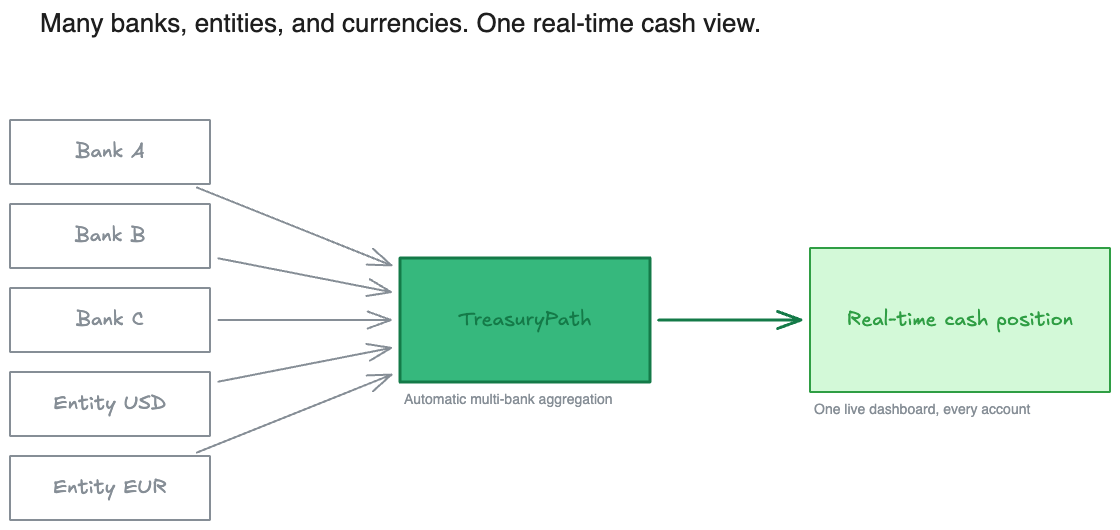
Why cash visibility matters
Cash visibility is more than a convenience. It is what lets a finance team manage liquidity, control risk, and report on the company’s financial health and stability with confidence.
Without it, decisions run on stale numbers. Teams hold larger cash buffers than they need, borrow to cover shortfalls that idle cash elsewhere could have funded, and find problems a day late. With a current, accurate cash position, the same team can:
- Manage liquidity deliberately - fund obligations from the right account instead of the closest one, and hold only the buffer each entity actually needs.
- Control risk - catch concentration in a single bank, a currency swing, or a shortfall forming before it turns urgent. Real-time visibility is the first line of treasury risk management.
- Report on financial health accurately - give leadership and lenders cash reporting that reflects today’s position, not last week’s spreadsheet.
For companies where cash sits across many banks, entities, and financial institutions, this is the difference between reacting and planning.
Cash visibility vs. cash flow visibility
The two terms are closely related and often used together:
- Cash visibility is the real-time view of cash you hold right now, balances and positions across accounts, banks, and currencies.
- Cash flow visibility extends that view over time, connecting incoming and outgoing payments so you can see how your cash position will change over the days and weeks ahead.
Most treasury teams need both: an accurate real-time position today, plus forward visibility into the cash flows that will move it tomorrow. This is where cash flow optimization and short-horizon forecasting build directly on the cash visibility foundation.
What a cash visibility tool does
A cash visibility tool (sometimes called cash visibility software or a cash visibility dashboard) brings fragmented bank data into a single, current view. For how to evaluate and choose one, see our cash visibility software buyer’s guide. The core capabilities are:
- Multi-bank aggregation - automatically pulls balances and transactions from every bank and account, so there is one source of truth instead of many bank portals.
- Real-time cash positioning - shows current balances and expected end-of-day cash as money moves, not on a 24-hour delay.
- Multi-currency cash visibility - normalizes positions across currencies so global cash is comparable at a glance, which also supports FX management.
- Dashboards and reporting - presents the cash position in a clear dashboard with the real-time reporting treasury and finance leaders need for decisions.
Together these turn raw bank data into the live picture that underpins effective treasury management and cash management.
Cash visibility and cash forecasting
A real-time cash position answers where your money is now. Cash forecasting answers where it is going. The two work together: accurate cash positions are the starting point that makes cash flow forecasting reliable.
When every bank balance and transaction already flows into one place, a 13-week cash flow forecast can be built and refined on live data instead of manual exports. Actual cash positions update the projection as money moves, so the forecast stays honest and the team can see a shortfall forming weeks ahead rather than the morning it lands.
This is why leading treasury teams treat cash visibility and cash forecasting as one workflow: see the position, project it forward, and act on both from the same system.
Cash visibility for multi-entity, multi-bank companies
The need for cash visibility grows with complexity. A company operating through several legal entities, dozens of bank accounts, and multiple currencies faces the hardest version of the problem, and gains the most from solving it:
- Multi-entity groups can consolidate cash positions across subsidiaries and jurisdictions, surfacing trapped or idle cash that would otherwise sit unused.
- Platforms that move money can see customer and operating balances together, so they can fund payouts and obligations without holding excess buffers.
- Finance teams managing many banking relationships replace a morning of logging into separate bank portals with a single, always-current view.
Best practices for cash visibility
- Aggregate every account automatically. Manual data pulls are stale the moment they are collected. Connect all banks so the position is always current.
- Work from real-time data, not end-of-day reports. Same-day balances and expected end-of-day cash are what enable confident funding decisions.
- Normalize across currencies. Make multi-currency positions comparable so global cash is visible in one place.
- Connect visibility to action. Cash visibility is most valuable when it flows directly into moving, sweeping, and funding cash, not just reporting it.
How TreasuryPath delivers real-time cash visibility
TreasuryPath aggregates balances and transactions from all of your banks into one real-time view, then lets you act on it: move money, fund obligations, and put idle cash to work from the same place you see it. Cash visibility is the starting point of a unified payments and treasury platform built for companies that operate across multiple banks, entities, and currencies.
Frequently asked questions
How do top firms gain real-time cash visibility?
Leading treasury teams connect every bank account through automated aggregation rather than manual statement pulls, so balances and transactions flow into a single platform continuously. That gives them same-day balances and expected end-of-day cash across all entities and currencies, instead of a fragmented, day-old picture assembled by hand.
What are the best platforms for cash visibility?
The strongest cash visibility platforms share a few traits: automatic multi-bank aggregation, real-time positioning, multi-currency support, clear dashboards, and the ability to act on cash (move and fund it) from the same system. The right fit depends on how many banks, entities, and currencies you operate across, complexity is what makes dedicated cash visibility worth it.
How do I compare cash visibility platforms for same-day balances, expected end-of-day cash, and funding decisions?
Compare platforms on three things: how current the data is (real-time vs. end-of-day), how completely it covers your banks and currencies, and whether you can move and fund cash directly from the visibility layer. A platform that only reports balances solves half the problem; one that connects visibility to action supports the actual funding decision.
What is a cash visibility dashboard?
A cash visibility dashboard is the single screen that shows your current cash position across every bank, entity, and currency. Instead of logging into separate bank portals, treasury and finance teams see aggregated balances, expected end-of-day cash, and recent movements in one live view, with the reporting they need to make funding decisions.
What is cash visibility software?
Cash visibility software automatically aggregates balances and transactions from all of your banks into one real-time view. The strongest tools go beyond reporting: they normalize multi-currency positions, connect to cash flow forecasting, and let you move and fund cash directly from the same place. For how to evaluate options, see our cash visibility software buyer’s guide.