Compute Is the New Payroll
Lately I've been asking founders a simple question: what's your AI bill as a percentage of burn? They can name headcount to the person. Then I ask about compute, and there's a pause. That pause is the problem.
Jeff Forkan · CEO & Co-Founder at TreasuryPath
July 6, 2026

Lately I’ve been asking founders a simple question: what’s your AI bill as a percentage of burn? They can give me headcount to the person. Salaries, taxes, the fully loaded number. Then I ask about compute, and there’s a pause.
That pause is the problem. For a lot of these companies the AI bill is already one of the largest costs they carry, and it’s the one nobody can name.
It’s compute. The bill for inference. The tokens. And it has quietly become a cost that rivals payroll.
For a traditional software startup, infrastructure is maybe 5 to 10 percent of burn. Servers, storage, the usual cloud bill. For an AI-native company, compute can run 40 to 60 percent of where the money goes. The cost structure didn’t shift. It inverted.
And it’s climbing. One large corporate card portfolio put average monthly AI token spend across its customers up 13x since the start of 2025. Not 13 percent. Thirteen times.
The shape of a company just changed
This goes deeper than a budget line. It changes what a company is.
The old model: revenue scaled with headcount. You hired people, people did the work, the work made money. Payroll was the biggest line because people were how the work got done.
The new model: revenue scales with compute. Midjourney reportedly did around $200 million in revenue with 11 people. That is the leading edge of a pattern, not an outlier. When models do the work instead of headcount, the bill moves from salaries to tokens. The engine of the business is something you meter, not someone you hire.
So the most important cost in these companies behaves nothing like the cost it’s replacing. Payroll is predictable. You know it on the first of the month. Token spend is variable and spiky and tied to usage you don’t fully control. A viral week, an agent stuck in a loop, a feature that triple-calls the model, and your largest cost just moved 30 percent with no warning.
Here’s the part that should worry every founder: by some counts, half of AI product companies don’t track this spend at all. They’re flying blind on their biggest, fastest-moving cost. You would never run payroll that way.
”But tokens are getting cheaper”
This is the objection, and it’s a good one. The price of intelligence is collapsing.
a16z’s analysis of what they call LLMflation found that for a model of equivalent performance, the cost of inference is falling roughly 10x every year. To hit a fixed quality benchmark, the price dropped from $60 per million tokens to $0.06 per million tokens in about three years. That’s a thousandfold decline.
So if the unit price of a token is in freefall, doesn’t the line item shrink itself into irrelevance? Won’t this problem just solve itself?
No. And the reason is one of the oldest observations in economics.
Jevons paradox, in your AI bill
In 1865, William Stanley Jevons noticed that as steam engines got more efficient and coal got cheaper to use, England burned more coal, not less. Cheaper made it useful for more things, and the more-things swamped the per-unit savings.
That is exactly what’s happening with tokens. As they get cheaper, we don’t spend less. We spend the savings on more: longer context windows, reasoning models that think before they answer, agentic workflows that make dozens of calls where we used to make one, products that were too expensive to ship last year and are no-brainers this year.
The proof is in the same data. Prices fell roughly 1,000x over three years. And in that same window, spend went up 13x. Both numbers are true at once. The deflation is real, and it grows the bill rather than shrinking it, because every price cut opens up a new use case that consumes more than the cut saved.
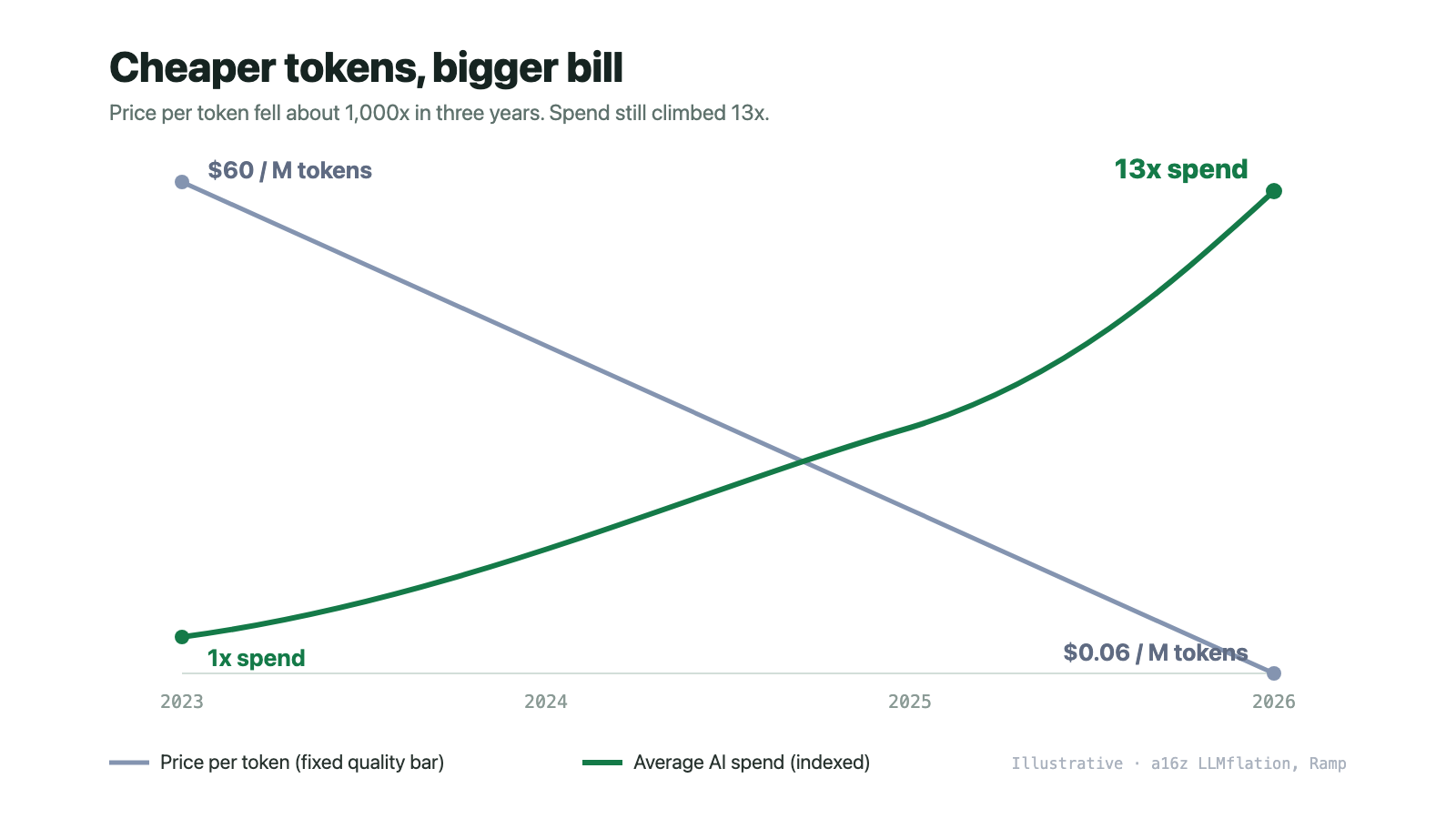
This is why the token tax is permanent. It is not a temporary cost of an immature technology that will optimize away. It is the structural, ongoing variable cost of building anything intelligent. The credit markets have already started calling it exactly that, a token tax, and repricing software companies on the assumption that it never goes to zero.
So run it like a real cost
If compute is your payroll, a few things stop being optional.
See it in real time. A cost that can move 30 percent in a week can’t be reconciled monthly. The teams that survive a bad month saw it coming on day three, not on the invoice.
Put it in cost of goods, not R&D. When AI spend was a rounding error, filing it under experiments was fine. Now it sits between you and your gross margin, so every product decision is also a unit-economics decision.
Give it a governor. Payroll has one built in: you know how many months of it you can afford. Token spend doesn’t have one until you set it. The most dangerous number in an AI-native company is how many weeks your burn actually buys once you count the AI bill that grew 13x.
And put someone technical in the finance seat. The CFO of an AI-native company needs to understand model routing and caching the way a manufacturing CFO understands a bill of materials. The cost driver is technical now. Finance has to be too.
The answer used to be the people
For most of software’s history, the answer to “what does it cost to run this company” was the people. Payroll. That era is ending for a fast-growing class of companies. The answer is becoming the compute, and the compute is volatile and here to stay.
The winners in this next stretch won’t be the ones with the cheapest tokens. Tokens get cheaper for everyone. They’ll be the ones who treat compute the way good operators have always treated their biggest cost: a number they actually watch, with a plan behind it.
Compute is the new payroll. Start running it like one.
Curious what your own AI bill is doing to your runway? Run the numbers in our free AI Spend calculator. Four inputs, no signup.
Sources: a16z “LLMflation” on the decline in inference cost; Ramp on AI token spend growth across its customer base; T. Rowe Price on the “token tax” framing in credit markets. Figures are 2024-2026.
Jeff Forkan · CEO & Co-Founder at TreasuryPath
Fintech expert with 10+ years in sales and product leadership. Built Gusto's cross-border payroll from $0 to $20M ARR. Previously Head of Fintech at RemoteTeam (acquired by Gusto).
See it for your platform
Want your own money map?
We'll draw how money and data actually move through your business, and where they leak time and cash. No pitch, just the picture.
Book a working session